
International Webinar: Academics from Indonesia, Malaysia, and Oman Call for Stronger Global Collaboration to Empower MSMEs through Digital Marketing, Artificial Intelligence, and Circular Economy
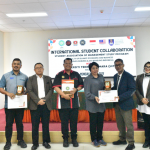
Terasjabar.co – The future of Micro, Small, and Medium Enterprises (MSMEs) lies in their ability to embrace digital transformation while remaining committed to sustainable development. This shared vision was highlighted during the International Webinar entitled “Digital Marketing for a Circular Economy: Empowering Local Business for Global Sustainability,” organized by the International Association of Economic and Business (IAEB) in collaboration with leading universities from Indonesia, Malaysia, and Oman. The webinar served as an international platform for academics, researchers, practitioners, policymakers, and business communities to exchange knowledge and strengthen cross-border collaboration in developing globally competitive and sustainable MSMEs.
The event was attended by participants from various countries and supported by several higher education institutions, including UIN Sunan Gunung Djati Bandung (Indonesia), Universiti Teknologi MARA (Malaysia), University of Technology and Applied Sciences (Oman), University of Buraimi (Oman), Universitas Muhammadiyah Sumatera Utara, and other IAEB partner institutions. The webinar reflected a growing commitment among universities to strengthen international academic cooperation in addressing global economic challenges through research, innovation, and community engagement.
Opening Remarks: Building Bridges Through Knowledge and Collaboration
Opening the webinar, the organizing committee emphasized that today’s global economy is undergoing rapid transformation driven by technological disruption, climate change, shifting consumer behavior, and the accelerating adoption of Artificial Intelligence (AI). These changes present significant challenges, but they also create unprecedented opportunities for MSMEs to innovate and expand into international markets.
The organizers stressed that universities have a strategic responsibility not only to generate knowledge but also to become catalysts for sustainable economic development by connecting academia, industry, government, and society. Through international collaboration, research partnerships, and knowledge exchange, higher education institutions can empower local businesses to become globally competitive while contributing to the achievement of the Sustainable Development Goals (SDGs).
The webinar was officially moderated by Masta Sembiring, S.E., M.Ak, Head of the Tax Policy and Management Study Program, Universitas Muhammadiyah Sumatera Utara, who guided the discussions and facilitated interactive dialogue among speakers and participants.
Keynote Address: Strengthening MSMEs through Sustainable Digital Transformation
Delivering the keynote address, Prof. Ts. Dr. Shafinar Ismail, Dean of UiTM Shah Alam, Malaysia, highlighted that higher education institutions play a crucial role in preparing future entrepreneurs capable of leading digital transformation with sustainability at its core. She emphasized that innovation, digital literacy, interdisciplinary collaboration, and responsible leadership are essential for creating resilient business ecosystems in the ASEAN region and beyond.
According to Prof. Shafinar, the integration of Artificial Intelligence, digital technology, and sustainability should not merely enhance productivity but also generate broader social and environmental value. She encouraged universities to strengthen collaborative research, student mobility, and industry engagement to accelerate sustainable innovation across borders.
Global Perspectives from Oman
Representing the University of Technology and Applied Sciences, Oman, Dr. Hamed Juma Al-Naimii, Head of the Business Studies Department, shared insights into the evolving role of higher education in supporting entrepreneurship and digital business development. He emphasized that digital transformation has become a strategic necessity for MSMEs seeking to improve competitiveness in increasingly interconnected global markets.
He also highlighted the importance of international partnerships in knowledge transfer, innovation, and entrepreneurial capacity building, noting that collaboration between universities and industry is essential for creating sustainable business ecosystems capable of adapting to rapid technological change.
Meanwhile, Dr. Weni Hawariyuni, Representative of IAEB Oman, emphasized the significance of international academic networks in fostering research collaboration and professional development. She noted that organizations such as IAEB provide valuable platforms for scholars, practitioners, and policymakers to exchange ideas, develop joint research initiatives, and strengthen institutional partnerships that contribute to sustainable economic growth.
Strategic Digital Marketing for Circular Economy Based MSMEs
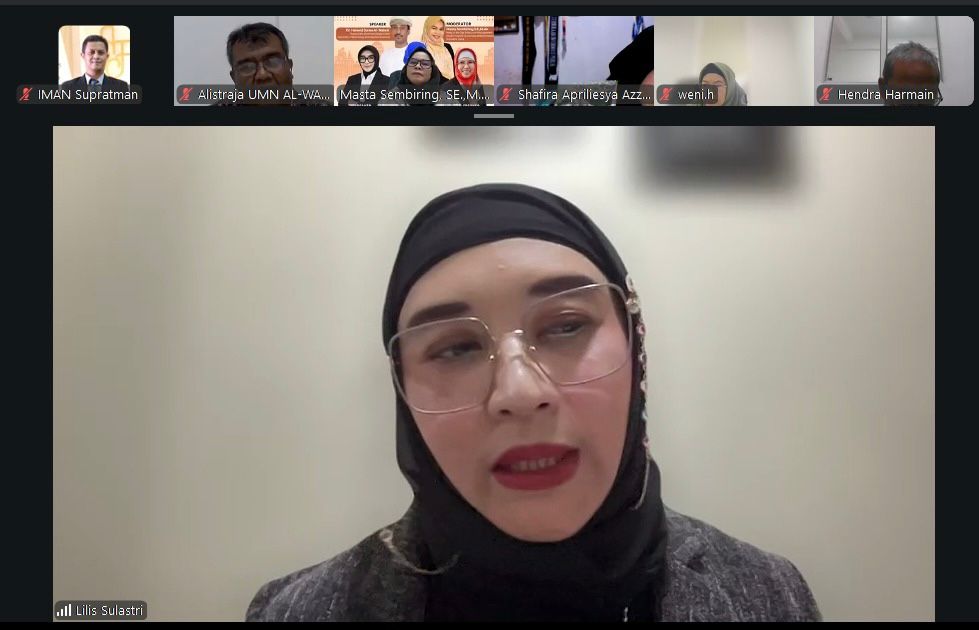
One of the featured speakers, Prof. Dr. Hj. Lilis Sulastri, M.M., Head of the Management Study Program at UIN Sunan Gunung Djati Bandung, Indonesia, presented a comprehensive framework entitled “Strategic Digital Marketing for Circular Economy-Based MSMEs: Building Sustainable Competitive Advantage in the AI Era.”
Her presentation emphasized that MSMEs currently face complex global challenges, including climate change, resource scarcity, economic uncertainty, rapid technological disruption, and increasing sustainability expectations.
Prof. Lilis explained that sustainable competitiveness can only be achieved by integrating digital transformation with circular economy principles. Rather than following the traditional linear model of “take–make–waste,” businesses should adopt circular practices based on Reduce, Reuse, Recycle, and Regenerate, enabling them to optimize resources while minimizing environmental impact.
She further highlighted that MSMEs represent more than 90 percent of businesses worldwide, making them a vital engine of employment, local economic resilience, and inclusive development. Therefore, strengthening MSMEs contributes directly to national prosperity and global sustainability.
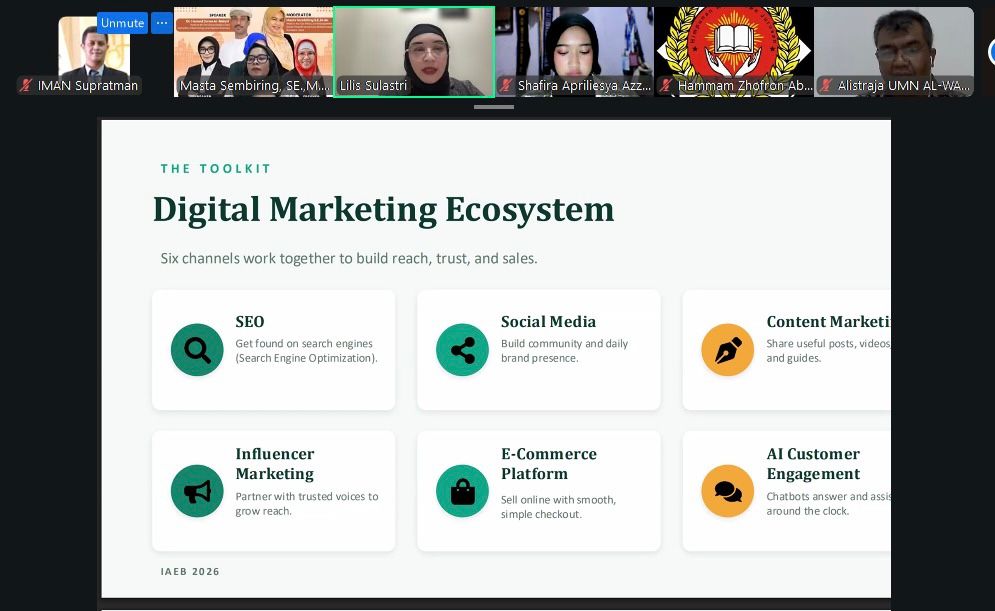
Prof. Lilis identified several emerging trends shaping business transformation in 2026, including AI-powered marketing, big data analytics, social commerce, marketplace ecosystems, and green consumerism. These trends require MSMEs to enhance digital capability while simultaneously developing human capital through continuous learning, digital skills, innovation culture, and green leadership.
She introduced a strategic framework built upon four interconnected pillars, Digital Capability, Human Capital, Circular Innovation, and Market Access which together create sustainable competitive advantage for MSMEs in the global marketplace.
Drawing on successful case studies from Indonesia, Malaysia, and Oman, Prof. Lilis demonstrated how circular business models and digital innovation have enabled enterprises to create economic value while addressing environmental challenges. She concluded with five strategic recommendations: digital upskilling, AI adoption, circular business innovation, cross-border collaboration, and sustainable branding as the roadmap toward future-ready MSMEs.
A Shared Commitment for Global Sustainability
Throughout the webinar, speakers consistently emphasized that the future of MSMEs depends not only on technological advancement but also on international collaboration, ethical leadership, innovation, and sustainable business practices. Universities were recognized as strategic partners in developing research, entrepreneurship, and human capital capable of responding to global challenges.
The event concluded with a shared commitment to strengthen international cooperation among universities, researchers, governments, industry, and business communities in building a resilient, inclusive, and sustainable global economy.
Closing her presentation, Prof. Dr. Hj. Lilis Sulastri delivered a message that resonated strongly with participants:
“Sustainability is no longer an option; it is a competitive strategy for the future.”
The webinar reaffirmed that empowering local businesses through digital innovation and circular economy is no longer merely an academic discourse. It has become a strategic agenda for shaping globally competitive MSMEs capable of driving sustainable economic growth and creating lasting value for future generations.

Leave a Reply